





Associate Professor, College of International Management
Ritsumeikan Asia Pacific University
Instilling the Power of Innovation in Organizations
Categories:
Management
#Entrepreneurship education#Innovation education#Interactive organizational development#International cooperative projects
Overview
Practical research that brings new creativity and growth potential to firms through a fusion of entrepreneurship education and organizational development (OD)
It has been recognized for a considerable amount of time that Japan lags in its endeavors in startups and innovation. Existing firms not only need to nurture individual entrepreneurs, but to also continuously innovate at the organizational level. In Japan, monozukuri (the art of manufacturing) firms in particular, have struggled in their efforts to innovate despite having superior assets in both human resources and technology.
A culture of entrepreneurship is imperative to both generate and sustain innovation in a highly uncertain environment. Companies require specific methodologies for fostering such a culture that are both effective and repeatable.
This practice-oriented research attempts to develop such methodologies by fusing entrepreneurship education with organizational development.
The defining characteristic of this research is its focus on designing processes that carefully consider the quality and quantity of interactions among different organizational actors. For example, practical workshops based on the “Appreciative Inquiry” (AI) method from organizational development theory and “effectuation” theory from the entrepreneurship literature, are known to be highly effective in helping existing firms and their stakeholders to innovate.
Many of the insights leading to the development of these workshops and training activities are the product of my unique experience and knowledge. In the mid-1990s, I interviewed a considerable number of startup founders and entrepreneurs in the United States as a journalist, and was struck by their speed and ability to seize opportunities which quickly translated into impact. Then, as a conference interpreter in Japan, I observed first-hand, how negotiations and decisions really unfolded at both startups and large corporates. I returned to the United States where I earned my MBA and Ph.D, then went back to Japan to teach entrepreneurship at a variety of universities. I engaged in a wide range of activities that included community outreach projects, research on “atotsugi” startups (startups and ventures founded by the successors of family businesses) and research on how monozukuri (the art of manufacturing) can facilitate entrepreneurship training and development. APU’s international environment has been an ideal sandbox for testing different innovation methods that are enabled by collaborations between students with diverse cultural backgrounds and organizations.
Based on my belief that “innovation is not driven by a special talent, but a culture nurtured through repeated practice across the entirety of an organization,” I pursue collaboration and practical research that brings new creativity and growth potential to firms.
Conceptual diagram of entrepreneurship educationand its relationship to the principal investigator’s practical research
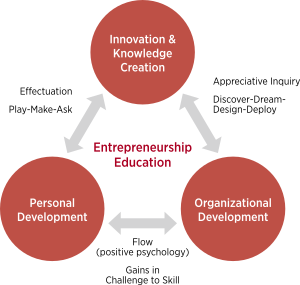
Novelty/Originality
Unconventional hands-on activities that foster entrepreneurship through “interaction” and “experience”
Knowledge transfer in and of itself is not enough to nurture entrepreneurship within organizations. In this research, unique approaches that emphasize practice and interaction between people coming from diverse backgrounds are chosen over formats that simply deliver information and codified knowledge.
The characteristics of this research strongly manifest themselves in workshops where participants engage in literally making something with their hands while simultaneously interacting through dialogue. For example, cooking together in teams is a powerful way to practice entrepreneurial thought and action, since ideas are given shape (in the form of dishes) through collaboration. One particular training program uses an advanced cooking device developed by SHARP called “Hot Cook”, so that participants can experience the connection between theory and practice in entrepreneurship. Such cooking workshops are not unusual overseas, but they usually happen in kitchens. The use of sophisticated devices like the “Hot Cook” allows a regular conference room or classroom to be converted into a kitchen and eating space.
This line of research combines theory and practice from different disciplines in management, in order to better understand how effective decision-making can unfold in highly uncertain environments. The theory of effectuation from entrepreneurship can be applied to organizational development methods for example, and vice versa. Case studies have been developed to analyze the processes that lead to innovation and knowledge creation, including a look at the University of Tokyo’s startup pre-accelerator “Hongo Tech Garage” and an academic spinoff emerging in rural Italy, the “Centro Studi Italiani”.
The multicultural environment of APU is leveraged to further develop effective processes for developing entrepreneurial culture. By realizing collaborations between students with differing cultural backgrounds and firms, this research seeks to create opportunities to identify seeds of innovation from global, diverse perspectives.
These endeavors represent practical and effective approaches that set this research apart from conventional, classroom-based management education and organizational development.
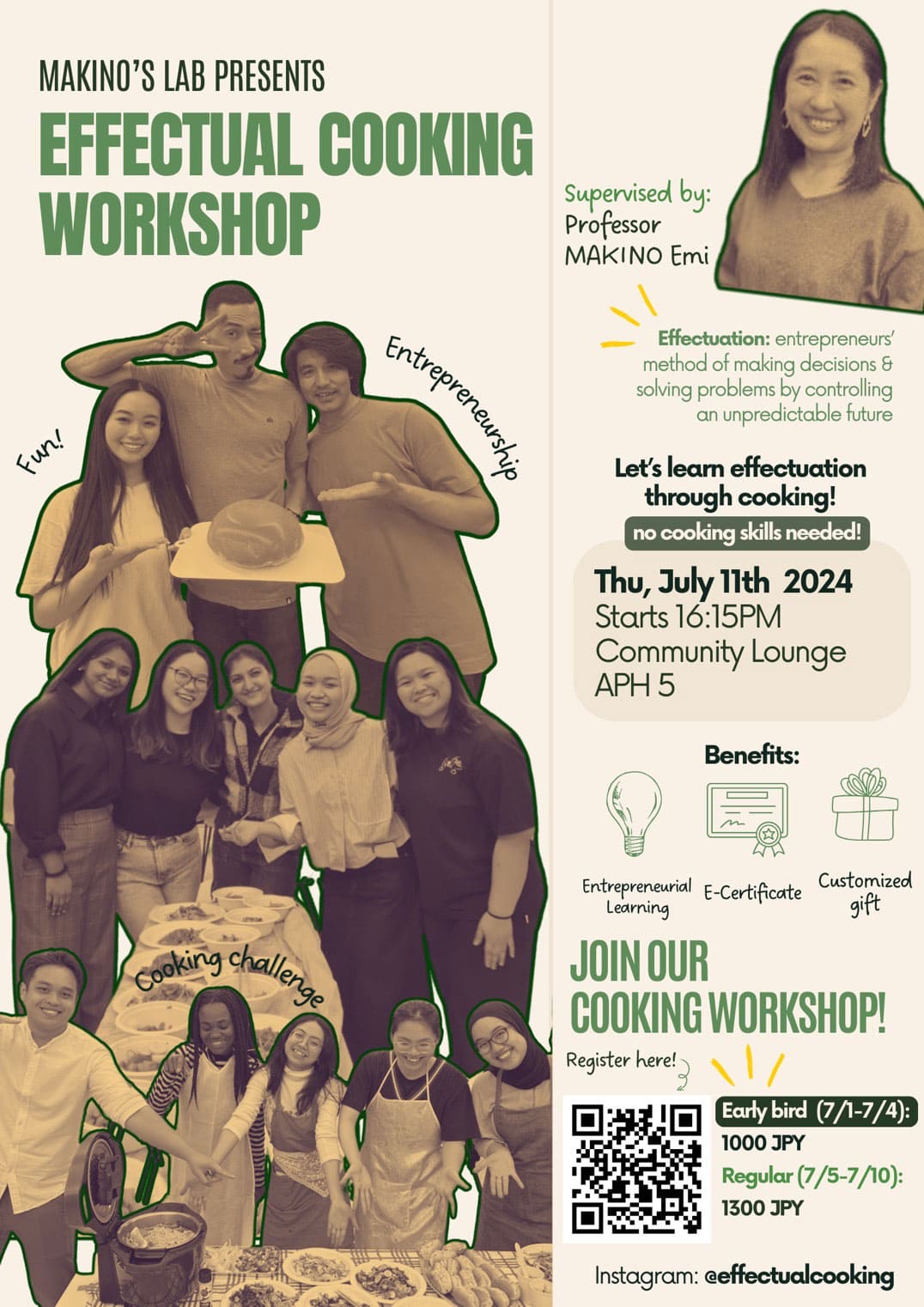
A poster announcing a workshop held on campus that used cooking as its platform. Prof. Makino and others are developing and implementing unique approaches to foster entrepreneurship.
Efforts towards Community Outreach
Enhancing the innovation capability of organizations through the provision of practical programs
The results of this research can be applied to the development of firms and organizations in a number of ways.
One example that can be cited is the provision of “entrepreneurship training program for firms” that stimulates the practice of innovation in organizations based on experiences such as interactive workshops in which participants learn through cooking and making novelty goods. This approach especially suits firms that possess advanced technology and engineering capabilities but are facing challenges in new businesses or product development. Such workshops may be able to draw out the creative power of the organization and its employees’ capacity for action.
Another example is the provision of an “organizational transformation program for managers and executives” that makes use of interactive organizational development methods. This program draws out creativity within the organization by appreciating what is, and using tools such as childrens’ toys to assist dialogue and communication among participants. There is great promise for using such methods for family businesses. The younger successors or “atotsugi” as they are known here, are in a unique position to revitalize the company through entrepreneurship. Efforts to turn an established business into a startup is known in Japan as “atotsugi ventures.” My research looks at different organizational development models that can be combined with entrepreneurship that can deal with both the opportunities and pitfalls for succession.
Collaborative projects between students and firms that leverage APU’s international educational environment is another characteristic endeavor of this research. Through collaboration with students that possess diverse cultural backgrounds, firms can gain opportunities for the creation of innovation from new points of view that are free from preexisting confines.
Furthermore, in this research, knowledge of the “Maker Movement” capitalizing on digital fabrication technology is incorporated to also provide assistance with innovation through monozukuri (the art of manufacturing). This endeavor, which involves supporting the emergence of innovation using technology by human resources with a humanities background as well, allows participation by a broader range of human resources. As such, corporate training that transcends conventional boundaries and the like are also possible.
As this illustrates, the practical approaches under this research are intended to enhance the innovation capability of organizations as a whole by going beyond nurturing entrepreneurs to also developing “intrapreneurs” at existing firms, and by having their diverse human resources work together while leveraging their individual strengths.
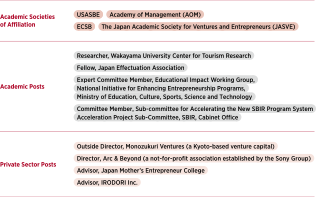
The principal investigator widely engages in diverse activities on and off campus and fuses together research, practice, and education.
Related Research
From Legacy to Entrepreneurship: Transformation through Succession and OD Practices
Principal Investigator
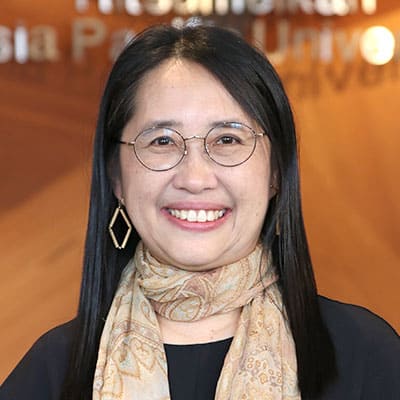
MAKINO Emi
You can view and print a summary of this page's contents in a single PDF page here.

As a Japanese journalist working in the United States in the mid-1990s, I had the opportunity to interview many entrepreneurs, corporate manageres executives in the emerging internet industry. This experience, coupled with my involvement in entrepreneurship education at Japanese universities, I have become acutely aware of the importance of human interaction and the physical act of making things for developing entrepreneurial capacity and competencies. For Japanese firms, leveraging existing strengths, is critical, and can be the shortest path for nurturing entrepreneurship across the entire organization. Working in the multicultural environment at APU will likely boost my ability to develop effective forums for interaction and creation at firms. More recently, I have been grappling with how to create an environment in which students studying arts and humanities and social science can make use of digital fabrication technologies to drive innovation. While the promises of the “Maker Movement” fell short in some ways, I still believe that tinkering offers an effective pathway for the creation of innovation inside organizations.
My background as a journalist and conference interpreter has honed my skills in synthesizing knowledge from different disciplines. The goal is to develop “forums for creation” that are conducive to participation by anyone, be they with a humanities or sciences background. My hope is that I can do my part for the sustainable development of organizations and society through the power of entrepreneurship and innovation.
Ritsumeikan Asia Pacific University Faculty Information
researchmap