Rather than Offering an Umbrella,
Getting Wet in the Rain Together:
Standing by the Young People
Who Gather Downtown at Night
Getting Wet in the Rain Together: Standing by the Young People
Who Gather Downtown at Night
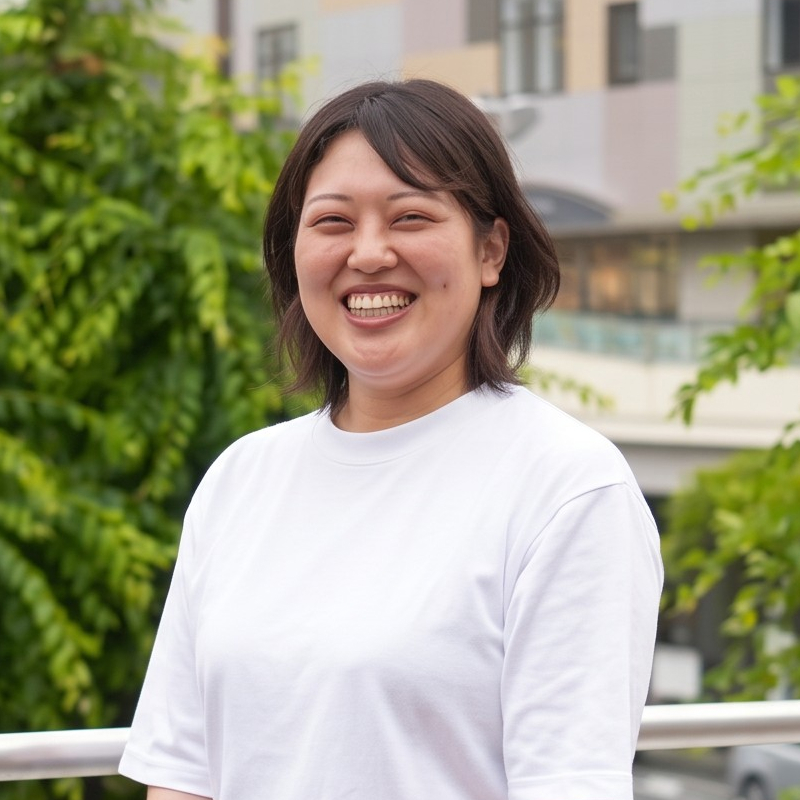
Soko Fujino


Introduction
Seeing Things from as Close to Someone’s Perspective as Possible
--- Approaching the young people who gather in the city at night and being the one to start the conversation: the roots of this work lie in her student days at APU. After enrolling, Fujino threw herself into the activities of a student NGO.
For my first year or two, I was completely absorbed in PRENGO, a student group that supports education in Thailand. It was a really demanding group. Twice a year, during spring and summer break, we’d go to Thailand to do educational support work, and the rest of the year we’d meet two or three times a week and spend all that time debating what we were going to do there. I’m still in touch with the friends I made there, from my own year and the years above and below.
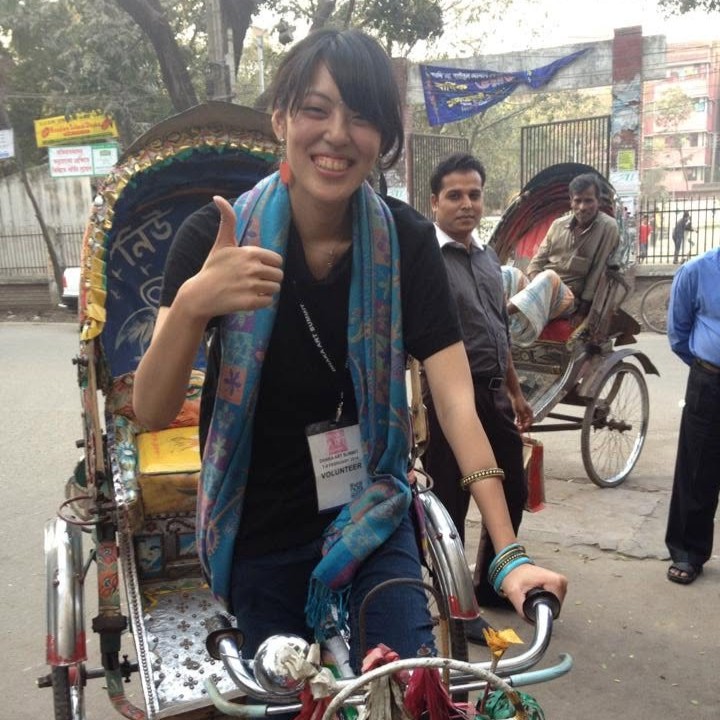
After visiting Thailand a few times with PRENGO, I became convinced there was a lot you couldn’t really understand unless you lived somewhere for longer. I wanted to spend an extended period in a developing country, so I took a leave of absence from APU and lived in Bangladesh for a year. I interned with the Grameen Bank group, going out to rural areas, accompanying staff on their field surveys, and looking after visitors from Japan. Spending six months living with a local host family was also a huge experience for me.
I guess you could call it learning to see things the way local people do. Being a foreigner, I’d take a “baby taxi”* when I needed to go somewhere far, but for local people it was normal to make long journeys by changing from one bus to another. Living with my host family, I felt those differences firsthand.
In my work now, when I’m listening to young people’s problems, I try to get a feel for what they’re going through, like, “Oh, maybe that’s how it is for them,” and to bring my perspective as close to theirs as I possibly can. I think that comes from my experiences with PRENGO and in Bangladesh.
*Baby taxi: a common name for small three-wheeled taxis (auto-rickshaws).
----Her student life spanned five years, including the year in Bangladesh. When asked about classes that stayed with her, she named two.
Professor Namba’s Entrepreneurship class came with heavy assignments, and he was very strict with us, but it was incredibly interesting. In the end we had to come up with our own business model, and I remember feeling a huge sense of accomplishment.
There was also a class on social stratification. We learned about the terrible working conditions of shipbreaking workers in Bangladesh, and since the “Kuroko’s Basketball” case* was happening in Japan around then, we read the perpetrator’s written statement and discussed it in groups. The lectures dug deep into a range of social issues, and it was one of the classes that opened my eyes to society. Quite a long time after graduating, I happened to find the lecture slides saved on my computer, and I still go back and look at them.
*The “Kuroko’s Basketball” case: In 2012-2013, a man sent a series of threatening letters to venues and businesses connected with the popular basketball manga Kuroko’s Basketball. The statement he made at his trial, describing his sense of failure and isolation, drew wide public attention in Japan.*
People Who Accept You Just as You Are
---After graduating, Fujino joined a startup in Tokyo. But things did not go the way she had pictured. She looks back on the years leading up to founding the NPO as “the first time I had tasted defeat after continuously succeeding at every challenge.”
After APU, I took a job at a company in Tokyo. What I really wanted was to work at an NPO straight out of university, but back then, and I think it’s still true now, NPOs almost never hired new graduates. So I focused my job search on startups and ended up at a fintech startup in Tokyo.
I meant to work hard there and build up experience, but in the end I quit after a few years. Looking back, I think I just couldn’t cope with the gap between the company’s vision and mission, which I’d really identified with, and the reality of a job where pursuing profit came first and everyone worked toward that. Of course, that’s only natural for a company, and most people find a way to come to terms with it. I’d assumed I’d manage once I was a working adult. But I couldn’t.
The first stretch after I came back to Fukuoka was pretty hard. Up until then, I’d done dance and ballet since elementary school, gone to a combined junior and senior high school in Fukuoka, worked hard at my studies, my student group and internships at APU, and gotten a job at a startup in Tokyo. In a way, my whole life had been one competition after another. Even after I came back, I still felt I had to “become somebody,” and I was constantly finding fault with myself. But then I realized there were people who supported me even as I was: family and friends who accepted me without my having to fight for it. That was when I was 26 or 27, and it was a huge realization for me. From then on, I felt I didn’t have to force myself to live for other people’s approval. Around that time, I set up a small organization of my own (not yet a registered nonprofit) and started a home tutoring service to help kids who weren’t going to school with their studies.
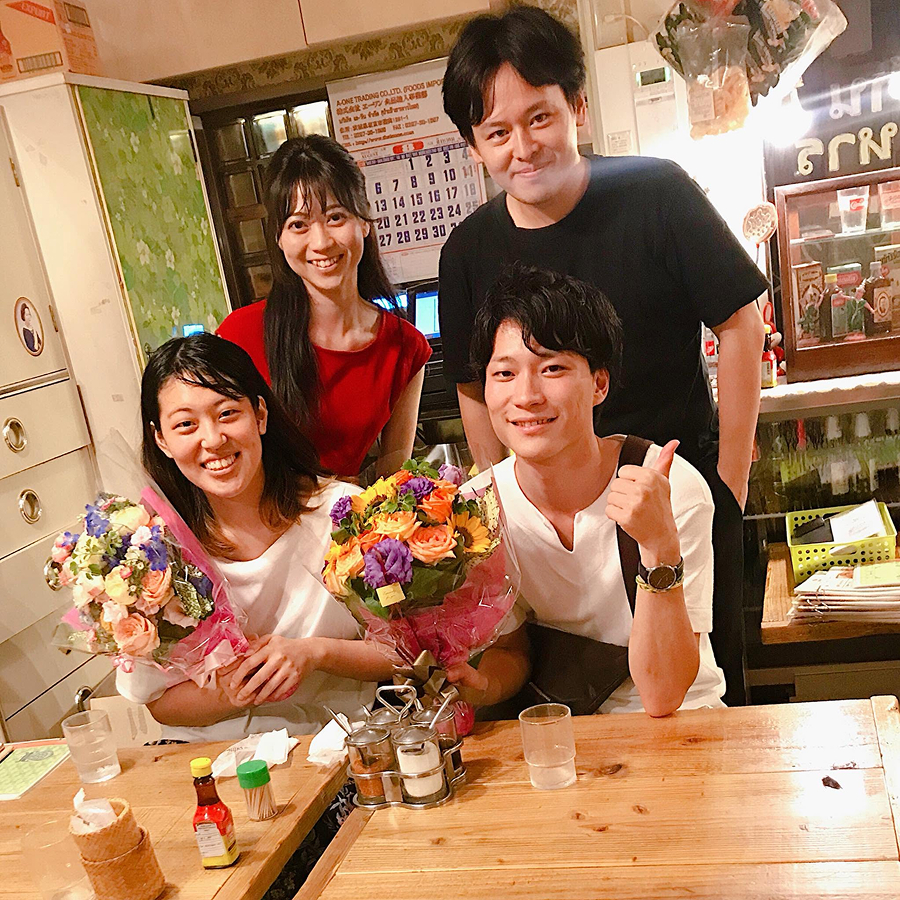
How the Work in Kego Park Began, and How She Relates to Young People
---Through her tutoring work, she became aware of children who would never be reached if she simply waited for them to come to her.
The tutoring was mainly for kids who weren’t going to school, and the lessons were basically paid. So every now and then I’d get inquiries from kids whose families were on public assistance, or who were living in children’s homes, saying they couldn’t afford the fees. It really struck me that there are children support will never reach if you just sit there saying, “Please come to us.” And I felt that these were exactly the people I wanted to reach.
Around then, I went to a talk by a group that was already working in Kego Park, and afterward I visited the park with other people who’d attended. That was in early 2022. At the time, terms like “Toyoko Kids” (young people who gather near a building in Shinjuku’s Kabukicho entertainment district in Tokyo) and “Kego Kaiwai” (a term for the young people who hang out around Kego Park in Fukuoka) were getting a lot of media coverage. I decided to start going there myself around July 2022.
Now I go to Kego Park and talk to the kids and young people who gather there. I ask whether they have somewhere to stay that night and what problems they’re facing, and depending on the situation, we help them find a place to stay or connect them with public services. There are three staff, including myself.
The kids who come downtown at night are basically young people who find it hard to be at home. Some aren’t going to school, some have no money, some have no adults or friends to rely on where they live, and so they end up in downtown Fukuoka, the biggest city in the region. By going out to meet them there and hearing about their real worries and circumstances, we can respond to the kinds of problems public agencies can’t deal with. We can reach them before things become serious, before they turn into real problems. That’s our strength as an NPO.
---How does Fujino, who keeps returning to Kego Park night after night, approach these young people?
Not everyone who gathers at Kego Park is like this, but I feel that a lot of them somehow don’t know how to trust adults. Kids like that can have extreme ways of relating to people. Some lean on you in a very dependent way; others are dead set on never relying on anyone. My sense is that it’s not so much that they don’t trust adults, but that they don’t know how far it’s okay to depend on someone. That’s how I see it.
Something that comes up a lot with them is testing behavior: seeing how much you’ll put up with. I used to think, “If they ask for help, I want to help,” and I’d try to meet their requests as far as I could. But once you get pulled into that, it gets messy. Now I think it’s more important to keep showing them, “You don’t have to test me like that. I’m here with you anyway.”
I try not to get too close or push them away, but to stay consistent in how I relate to them. That’s actually pretty hard in its own way. But when these young people come to feel, “Nothing I say will change this person,” or “Whatever happens, this person stays the same way and will always be there,” then, and I’m not sure you can call it trust, I feel we can build a relationship over time.
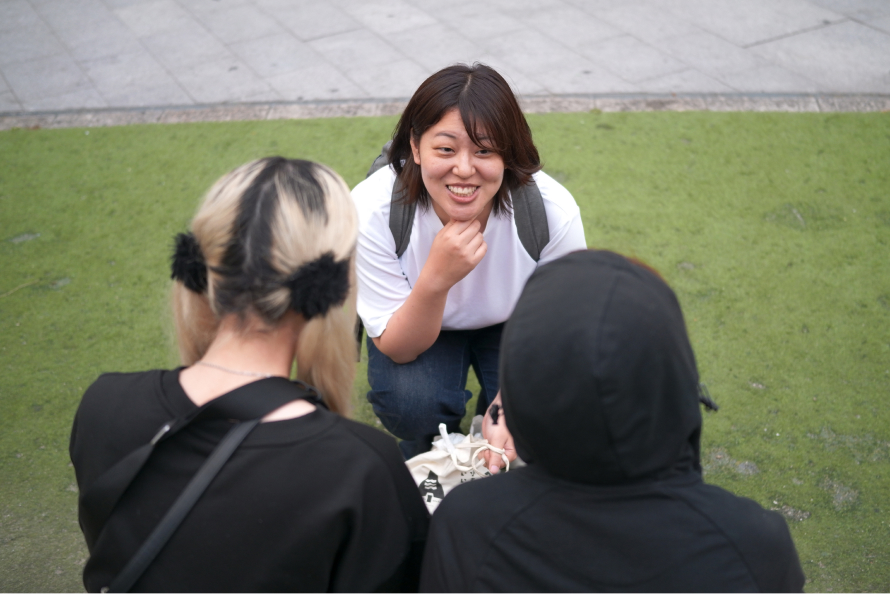
Rather than Offering an Umbrella, Getting Wet in the Rain Together
---How does this commitment to “staying consistent with each young person” play out in practice? As an example, Fujino described how she responds to an SOS from a young person who has run away from home.
For example, we’ll get a message saying, “I’ve run away from home. Please help me.” We talk with them, and if the situation is serious, we suggest connecting them with support from public agencies. If they’re an adult and it’s the weekend, we book a hotel until Monday, and on Monday morning we go with them to the city office to apply for public assistance or other support. Even so, some of them slip out of the hotel partway through and disappear.
Even then, I try as much as I can not to think, “We went to the trouble of booking you a hotel,” or “I’m doing this for you, so why would you let me down?” Basically, if we think something is the right thing to do, we do it, and if we don’t want to, we don’t. Ultimately, I’m doing this because I want to. I think what matters is whether I can honestly say yes to that.
I tell the young people, too: “It’s not that I’ll only support you if you grow or try hard. I’m on your side no matter what.” That’s also so the relationship doesn’t become transactional. If you’re doing this expecting something in return, like being thanked or seeing them become independent, then you probably shouldn’t be doing this kind of work.
---No expectation of reward, no strings attached. Behind this distinctive approach lies a clear sense of where she stands as an NPO. Fujino explained it with the metaphor of an umbrella and the rain.
As an NPO, I always want to take on what public agencies can’t. Compared with even a little while ago, the system now offers far more places for children and young people in difficulty to turn to. If there’s domestic violence, child welfare services step in right away, and support systems have been put in place for all kinds of issues: suicide prevention, young carergivers, LGBTQ, and so on.
That’s a really good thing in itself. But it can lead to responses like, “So, you have this problem, which means you need this kind of support, right?” To use the rain metaphor, it’s like saying, “You need this umbrella, so here’s an umbrella.”
What we want to do is, before offering an umbrella, first get wet in the rain together. These kids are surrounded by doctors, staff at the relevant city departments, child guidance centers and school counselors. There are plenty of people with professional expertise telling them sensible, correct things. And yet there are still kids that support doesn’t reach, and kids whose problems have become tangled and harder to resolve. If that’s the case, I think someone who can offer support from a different angle is needed.
For example, we’ll go and help clean up a home that’s buried in trash, or go to the laundromat with them. We stay close to their everyday lives that way. Rather than handing them a tool, as in “here’s a way to solve your problem,” we ask, “How are you doing right now? What’s on your mind?” We jot things down on whatever scrap of paper is lying around and talk it through together: “So this is where things are now, so maybe it’d be good to head in this direction.” Being able to do that as equals, without pushing anything on them, may be what makes us who we are.
--- Four years after she first started going to Kego Park, her work is about to enter its next stage.
Looking ahead, we’re preparing to start the same kind of “downtown outreach” we do in Kego Park in Kurume. More support groups are now active in Kego Park, and we’ve built up experience of our own, so we decided to start in Kurume, where the situation is similar.
In the long term, I’d also like to help develop people for NPOs in Fukuoka. I’m in my thirties now, and I don’t think it’s good that I’m the youngest person at a manager level at NPOs in Fukuoka. I don’t know how much I’ll be able to do, but it’s one of the things I want to do.
And beyond that, of course, it’s about continuing my work in this field. Making each choice, moment by moment, that I can truly stand behind. That, to me, is what success means. It’s what matters most.
Other Interview
Living as a Bridge — Across Borders, from Tourism to Human Development and University Building
Polestar Services Co.,LTD.
Chairman & CEO
Sharing Beppu’s Appeal Worldwide Through Music: From a Relentless University Life to a Music Bar Rooted in Local Community
Founder and Owner of DJ Bar "The Hell" and Listening Bar "TANNEL"

Passing the Torch: Lighting the Path Through Education
Co-founder and Board Chair of HOSHIZORA Foundation
Director at Deloitte Touche Tohmatsu Limited
Inspired by Sony, Fueled by Ambition: Empowering SMEs in Mongolia and Beyond
CEO and Co-founder of InvesCore Financial
Creating a Work Environment Where Women Thrive through Agriculture: How Motherhood Led to Starting a Business
Woman Make Co., Ltd.