Downloads
 Inquiry
It's more than just a gathering of students from around the world.
The world will change you.
 HOME
HOME- Multicultural Collaborative Learning
Multicultural Co-Learning in EDLSC
EDLSC develops a unique Multicultural Co-Learning*1 model which enables students to take advantage of APU’s international environment and collaborate by learning from one another through different perspectives and values.
Since 2011, EDLSC has offered Multicultural Co-Learning courses for all first-year students, with the support of Student Assistants (SA)*2.
- *1Multicultural Co-Learning: In our context, this refers to the process in which students, while collaborating in a multicultural setting, utilize each other’s diversity as a resource and learn from one another.
- *2In EDLSC’s Multicultural Co-Learning courses, over 100 undergraduate SAs support all first-year students (approximately 1,200 students).
-
1. Why Multicultural Co-Learning?
Acquire specialized knowledge in APU’s classrooms where students with diverse backgrounds gather.
Support one another and grow together in a multicultural environment—whether through dorm life or extracurricular activities.
And to create an inclusive community with their own hands.
EDLSC's Multicultural Co-Learning forms the foundation for all of this.
-
2. What happens here?
In APU’s multicultural co-learning environment, students face many kinds of diversity such as in language, communication styles, and approaches to discussions and tasks.
As a result, mutual understanding and decision-making can take time, and misunderstandings sometimes arise.
However, within this process, students will encounter ways of thinking that they have never encountered before and experience having their own assumptions and preconceptions challenged.
-
3. What can students gain?
The ability to be curious with others, exchange perspectives, and build connections.
The ability to generate new ideas while enjoying the differences they encounter.
Resilience with in navigating ambiguity and intercultural understanding.
And the ability to co-create inclusive spaces.
The experience of collaborating and taking on challenges together with peers from around the world will serve as a solid foundation for thriving in a global society.
EDLSC’s Multicultural Collaborative Learning Model
—The features of the model and utilization of SA (student assistants)—
A model example is our freshmen course, “Multicultural Cooperative Workshop (MCW).”
-
Feature1
Project-Based Course with Multinational Groups
Students are assigned to multinational teams that mix Japanese-based and English-based students and remain in the same group throughout the semester. In the first half, through lectures and experiential exercises, students learn about multicultural collaboration, cultivating belonging, and creating inclusive spaces. They develop practical skills such as active listening, encouraging participation, expressing gratitude, and leveraging strengths. In the second half, students apply these learnings to design and implement socially meaningful projects, such as “Designing Belonging.” The entire course is structured as PBL (Project-Based Learning) within a multicultural group.
-
Feature2
Curriculum Designed to Enhance Inclusion
While collaborating with diverse peers, students will acquire the knowledge, skills, and attitudes necessary to foster a sense of belonging and create inclusive environments. Although students may encounter language barriers or differences in values and working styles, navigating these challenges itself becomes a vital learning experience. Through exploring diverse and fluid identities and engaging in dialogue and collaboration, students cultivate the will and practical ability to co-create more inclusive cultures and communities within and beyond APU.
-
Feature3
SAs Support Multicultural Collaborative Learning
In multinational groups, discussions may not progress as smoothly as intended due to communication difficulties or differences in approach. SAs provide careful support to the groups so that these challenging situations can be transformed into learning opportunities. Trained SAs—both Japanese-basis and English-basis—work in pairs to encourage learning through multicultural collaboration. SAs also serve as approachable role models where students can easily consult with. By supporting first-year students from around the world, SAs make a significant contribution to creating inclusive classrooms.
-
Feature4
Quality Assurance for SA Activities
In MCW, faculty members lead the first half of the lectures, while SAs lead the subsequent exercises in small classrooms. To ensure the quality of learning, Leader SAs (LSAs) supervise each SA’s classroom along with the faculty. LSAs also facilitate pre- and post-class meetings to support SAs in improving their classroom management and facilitation.
Class Operation Method
In the first half of the class, faculty members deliver lectures in Japanese and English separately to support and deepen understanding of the course content.
Subsequently, in small group sessions led by SAs, students work in diverse groups, in which Japanese- and English-basis students are combined, on practical exercises and projects.
Faculty members and LSAs supervise the small group sessions led by SAs to assure the quality of learning. Pre- and post-class meetings for SAs are conducted by LSAs.
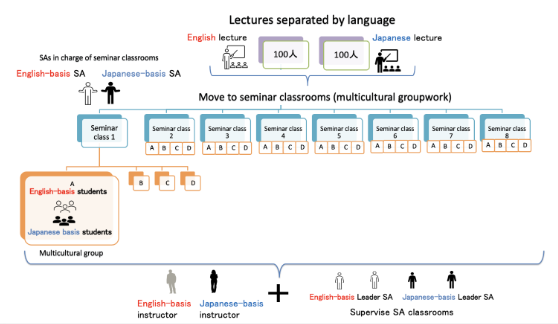
<The image of the class operation>
A Multicultural Co-Learning Model Utilizing SAs and Its Effects
-
Creating leadership cycles inspiring freshmen to become SAs
By observing SAs in action, many freshmen aspire to become SAs themselves. Their reasons vary: “I want to support freshmen just like my SAs did for me,” “I want to play a key role as my SAs,” “I want to take on challenges in a multicultural environment,” and “I want to develop my leadership skills.” Having SAs in first-year courses creates a “cycle of leadership” that cultivates the next generation of SAs.
-
SA growth
Through practical experience in a multicultural environment, SAs comprehensively enhance their interpersonal, collaborative, and problem-solving skills. Below are examples of how SAs perceive their own growth, based on post-course reflections.
- Empathy grows as they work with students from diverse backgrounds.
- Communication and collaboration skills improve through coordinating classes in partnership with faculty, Leader SAs, and fellow SAs.
- Language proficiency improves by teaching with an SA partner from the opposite language basis.
- Collaborating with an SA partner from a different cultural background helps to learn about various work styles and value differences.
- Dealing with unexpected situations and managing classes that do not proceed as planned fosters flexibility and problem-solving skills.
- Leading small classes enhances leadership, facilitation skills, and a sense of responsibility.
-
Creating an inclusive campus where multinational students contribute to education
For SAs, the freshmen course they lead serves as a platform for contributing to APU’s educational mission. Having experienced first-year courses themselves, SAs are now in a position to support students, allowing them to offer suggestions for improving education from a student’s perspective. APU’s utilization of SAs creates an inclusive campus where many multinational students actively contribute to education.
Fostering the ability to learn, connect,
and take on challenges in a multicultural setting—
that is MCW.
VIEW MORE
STUDENT ASSISTANTS
Supporting Multicultural Co-Learning
Senior undergraduate students are trained to serve as Student Assistants (SAs), facilitating collaborative learning among students from diverse backgrounds. SAs support junior students in their learning, and those who receive support are often inspired to become SAs themselves—creating a positive cycle of leadership development. In the Multicultural Cooperative Workshop (MCW), a two-tier structure is in place: Leader SAs support SAs, and SAs support freshmen.
Student Activities
You can view the activities of students serving as Student Assistants (SAs) on the following
 Instagram