

 Downloads
 Inquiry
FD (Faculty Development) & IR (Institutional Research)
Two Driving Forces Supporting the Quality of Education at APU
Pioneering the Future of Learning Through Educational Innovation and Data-Driven Insight
 HOME
HOME- FD (Faculty Development) & IR (Institutional Research)
Through the promotion of FD, we cultivate a culture of continuous improvement in teaching and learning, while IR enables us to visualize and assess student growth based on evidence.
Faculty Development (FD): Pursuing APU-Style Education and Enhancing Educational Quality
This initiative supports faculty and staff in sharing and reflecting on their valuable educational experiences within a multicultural environment, while continuously striving for improvement. By leveraging learning data and insights from educational research, we consistently examine and enhance the quality of education to meet the diverse needs of our students.
APU Teaching Hub
At APU, faculty and staff teach and support learning in one of Japan’s most diverse educational environments.
The APU Teaching Hub is a place for educators to connect, reflect, share ideas, and continue growing together.
-
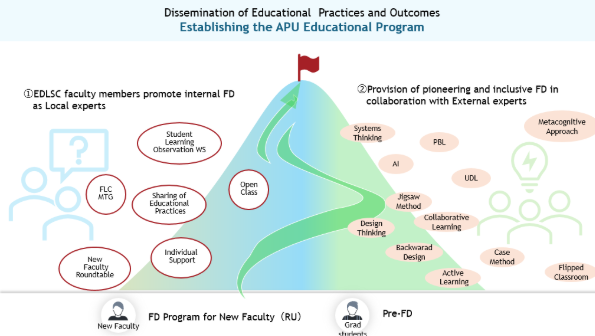
 Through events, workshops, and opportunities for dialogue, we support teaching as a professional practice. Our activities encourage faculty members to exchange experiences, reflect on their classrooms, and explore new approaches to teaching and learning.
-
-
New Faculty Roundtable Meeting
A welcoming space for newly appointed faculty members to meet colleagues, share their academic backgrounds and teaching interests, and build connections across colleges and disciplines.
-
Faculty Learning Community Meeting (FLC Meeting)
A regular opportunity for faculty members to reflect on classroom experiences, discuss emerging teaching challenges, and exchange practical ideas for improving learning.
-
Student Learning Observation Workshop
A workshop where faculty members observe how students learn, collaborate, and develop understanding during class, then discuss their observations with colleagues.
-
Individual Support
One-on-one consultation for faculty members who would like to discuss course design, classroom challenges, student engagement, assessment, or other aspects of teaching practice.
-
Open Classes
A supportive space where faculty members open their classes to colleagues, exchange feedback, and learn from one another’s teaching approaches.
-
-
Planning and implementation of training sessions and events for faculty and staff related to international education.
-
- Systems Thinking
- PBL Seminar
- AI Workshop
-
Development and evaluation of educational resources suited to APU’s diverse learning environment*
-
(*For example, creating learning environments that support a sense of belonging within diversity.)
INTERVIEW
Accelerating Student Learning: Classroom Practice Interview Series
“Why is this class so engaging?” — We take a deep dive into the secret behind it.
To share each instructor’s innovations and Quest for better teaching,
and to connect these efforts to improving the Quality of other classes, we conduct student-led interviews.
By exploring the key Questions instructors value
and the practical wisdom behind their teaching, we share insights that contribute to continuous educational enhancement.
Institutional Research (IR): Visualizing the Quality of International Education at APU Through Data
The Mission of IR: Making Student Growth Visible and Advancing Educational Improvement
Academic IR comprehensively analyzes students’ learning outcomes and development—from enrollment to graduation—using reliable, evidence-based data.By leveraging this evidence, we promote curriculum optimization, continuous educational improvement, and enhanced academic support, thereby strengthening the APU education brand.
Our IR uses the Global Perspective Inventory (GPI), the internationally recognized assessment tool, to measure APU’s global learning.
APU’s educational IR uses the Global Perspective Inventory (GPI), an internationally recognized assessment tool, to measure the university’s global learning outcomes. In the university-wide first-year multicultural co-learning course, we have not only observed growth in GPI scores but also obtained data-informed educational feedback. Under the “Multicultural Campus Project Toward Social Impact,” for which APU was selected, we have also introduced the GPI’s social impact indicators and begun university-wide measurement of competencies related to the creation of social impact. Furthermore, we have initiated joint research on the GPI with Kyushu Institute of Technology, our partner institution jointly selected for the project and are advancing educational discussions based on data from both institutions.
Key Activities of IR: Establishing a Data-Driven PDCA Cycle
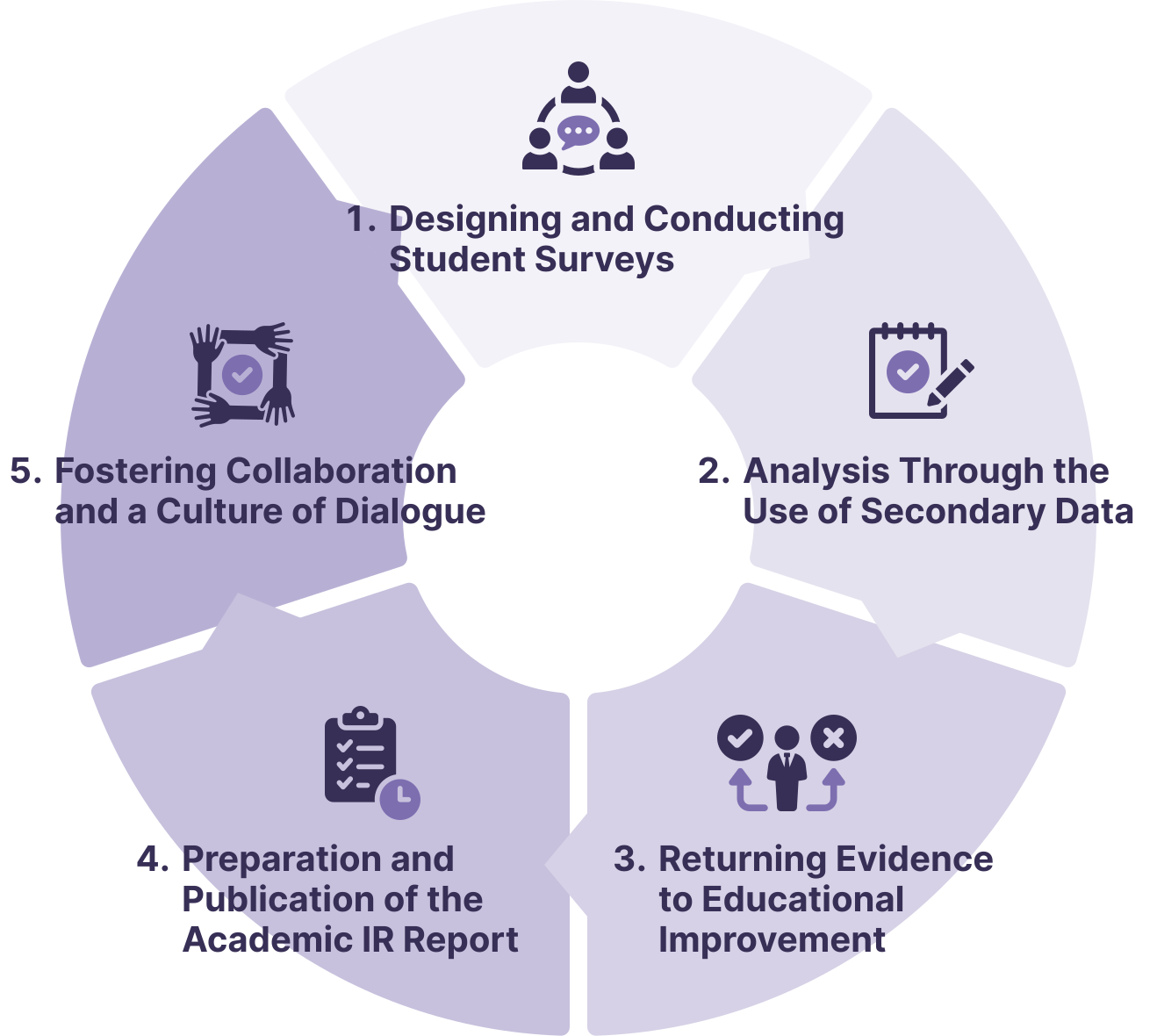
Through the analysis of learning outcomes and student data, IR supports a university-wide PDCA cycle that continuously enhances the quality of education.
-
1. Designing and Conducting Student Surveys
We systematically design and implement surveys to capture the realities of student learning and convert the findings into actionable data.
-
2. Analysis Through the Use of Secondary Data
By integrating a wide range of data—such as grades, credits earned, and time spent on activities—we make student growth visible from multiple perspectives.
-
3. Returning Evidence to Educational Improvement
We provide feedback based on analytical results, guiding educational enhancement and academic support through data-driven insights.
-
4. Preparation and Publication of the Academic IR Report
We compile annual reports summarizing key findings, demonstrating the credibility and transparency of APU’s educational initiatives to both internal and external stakeholders.
-
5. Fostering Collaboration and a Culture of Dialogue
Through data-informed dialogue among faculty, staff, and students, we promote a culture in which education is actively discussed and continuously improved.


