

 Downloads
 Inquiry
Education Design
In the first-year education program,
APU fosters students’ “ability to continue learning” and “multicultural collaborative competence” in line with a structured educational framework.
Through leadership development, career formation, intercultural communication, and overseas programs,
students cultivate diverse perspectives and practical skills.
 HOME
HOME- Education Design
FIRST-YEAR EDUCATION
Students from all over the world gather at APU.
EDLSC offers first-year students workshop-style courses designed to help them learn and grow by taking full advantage of the APU environment.
-
SSW
Student Success Workshop
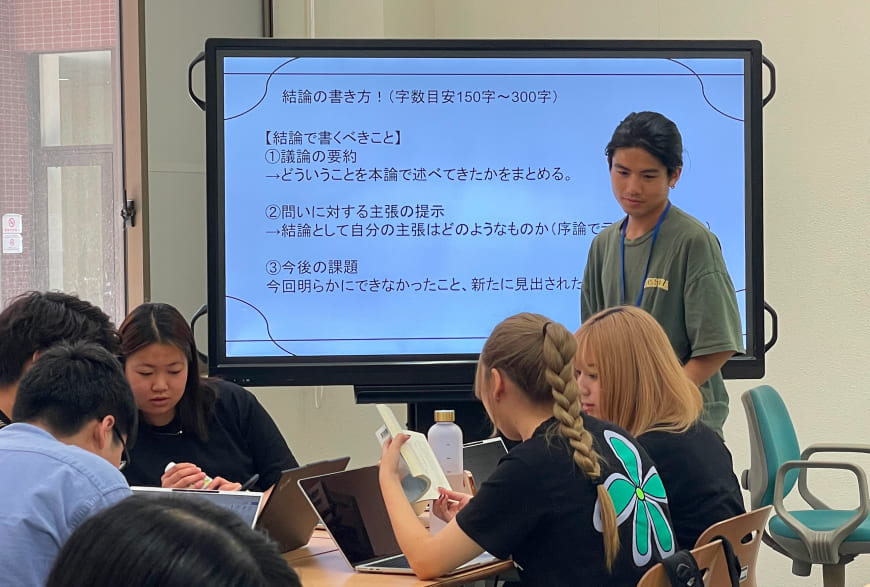
Developing Academic Skills for a Fulfilling University Life
Students acquire essential academic skills, including how to learn effectively at university and how to write academic papers. University is not a place where students simply receive knowledge; it is a space where they actively construct their own learning. Therefore, students are expected to develop self-regulated learning abilities—planning, implementing, reflecting on, and improving their learning processes. These abilities form the foundation not only for success at university but also for lifelong learning beyond it. In addition, universities place strong emphasis on the ability to articulate ideas clearly and logically through writing, while engaging in intellectual dialogue with others. Academic writing is not merely about mastering report or thesis formats; it is a process that deepens critical thinking and supports the development of well-reasoned perspectives. Through this process, students strengthen their ability to think independently, communicate effectively, and act thoughtfully and responsibly in society.
-
MCW
Multicultural Collaboration Workshop
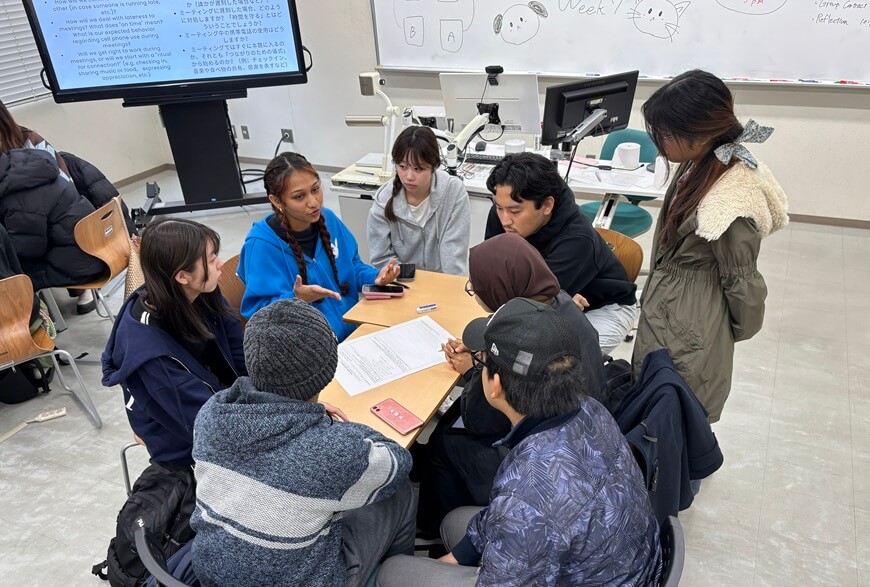
This project-based learning (PBL) course is designed for all first-year students to maximize learning within APU’s international environment.
Students are assigned to multinational teams that mix Japanese-based and English-based students and remain in the same group throughout the semester. In the first half, through lectures and experiential exercises, students learn about multicultural collaboration, cultivating belonging, and creating inclusive spaces. They develop practical skills such as active listening, encouraging participation, expressing gratitude, and leveraging strengths. In the second half, students apply these learnings to design and implement socially meaningful projects, such as “Designing Belonging.” The course structure is distinctive: students first attend language-specific lectures in a large classroom, then move to smaller classes for mixed Japanese-English group work. Trained, multinational SAs facilitate exercises and support multicultural collaboration. Although students may encounter language barriers or differences in values and working styles, navigating these challenges itself becomes a vital learning experience. Through exploring diverse and fluid identities and engaging in dialogue and collaboration, students cultivate the will and practical ability to co-create more inclusive cultures and communities within and beyond APU.
(Related Link: https://en.apu.ac.jp/home/study/content55/)
GLOBAL LEADERSHIP
Learn leadership as a relational, collaborative process
that respects diversity and drives positive social change.
-

Foundations of Global Leadership
(FGL)Grounded in the Relational Leadership Model, this course has students practice active listening, facilitation, conflict management, and critical reflection.
-

Skills and Practice
for Global LeadershipThis course focuses on practical skills and methods for inclusive leadership. It supports students in addressing social challenges, covering topics from the fundamentals of project management to delivering engaging presentations.
-

Global Leadership
Social ImpactApply systems thinking, loop diagrams, and Theory of Change to understand and practice how organizations and communities drive transformation.
STUDENT ASSISTANTS (SA)
Approximately 300 Student Assistants (SAs) each year support first-year courses and Global Leadership courses.
From a position close to fellow students, SAs promote collaborative learning by facilitating dialogue and providing feedback.
-
 The Role of Student Assistants (SA)
-
At APU, SAs play an active role in First-Year Education courses (MCW and SSW) and in Foundation of Global Leadership (FGL) courses. The SA system is one of APU’s distinctive features. By engaging closely with students, SAs help deepen each learner’s academic experience.
-
SA Development and Training
-
To ensure the quality of instructional support, SAs participate in structured training, including pre-semester training, mid-semester training, and final training before the semester concludes. In addition, weekly pre-class and post-class meetings provide opportunities for peer learning and continuous improvement.
Training content varies by course. Pre-semester sessions cover course understanding, team building, SA skills, and goal setting. Mid-semester training focuses on reflection and skill enhancement. Final training emphasizes growth reflection and feedback to faculty. In some courses, Lead Student Assistants (LSAs) support faculty in managing SAs and facilitating meetings and training sessions. -
Educational Impact of SA Activities
-
University research shows that former SAs experience significant growth in non-cognitive skills. Many students are inspired by SAs in their classes and aspire to become SAs themselves, creating a positive cycle of leadership development. Skills developed through SA experience vary by course but commonly include:
- Communication skills bridging students and faculty
- Facilitation skills to deepen learning
- Presentation skills for clear explanations
- Management skills to carry out responsibilities effectively
A 2023 survey of 115 MCW SAs (then called Teaching Assistants) identified growth in empathy, flexibility, communication, global relationships, and teamwork as top competencies. Many SAs who have completed job hunting report that skills gained through SA work were highly beneficial in interviews.
(Related Link: https://en.apu.ac.jp/academic/program/first-year-education_fgl_sas/)
CAREER EDUCATION
In a way that is distinctly APU, we support each student in pursuing a diverse and dynamic way of life grounded in their own values, empowering them to spread their wings to the world—particularly across the Asia-Pacific region. We also promote career development as practical, real-world learning that connects academic specialization with society.
Policy and Key Features |
|---|
|
In classes composed of students from diverse nationalities and cultural backgrounds, active learning is used to deepen self-understanding, social awareness, and understanding of organizations and businesses. Through this process, students cultivate a rich and authentic career vision that reflects their individuality. |
Programs Structure |
|
INTERCULTURAL COMMUNICATION
Through learning in APU’s multicultural campus environment, students progressively acquire knowledge and skills—from understanding fundamental concepts to applying and practicing them in real-world contexts.
Introduction to Intercultural Communication / Application and Practice of Intercultural Communication
These courses deepen students’ awareness and understanding of diverse cultures by connecting theoretical learning with APU’s multicultural environment and intercultural experiences. In the advanced course, students also participate in Collaborative Online International Learning (COIL) with Tianjin Normal University in China, engaging in international online collaboration.
LEARNING ABROAD PRAGRAMS
Learn on a global stage through FIRST/SECOND freshman programs
mid-term Service Learning.
FIRST/SECOND
(Freshman Abroad)
After preparatory classes, conduct small-group fieldwork abroad. Navigate to destinations without relying on phones, and—cultivateing autonomy, initiative, collaboration, and intercultural insight.
Destinations: |
FIRST—1 country in East Asia; SECOND—2 countries in Southeast Asia |
|---|---|
Participants: |
FIRST—primarily domestic; SECOND—mixed domestic & international |
Language: |
FIRST—Japanese; SECOND—Japanese & English |
SERVICE LEARNING
This is APU’s only mid-term study abroad program that combines English language study, auditing of specialized academic courses, and work experience on campus and in the surrounding community.
In this program, students study English for three months at the English Language Center (ELC) of the prestigious University of Texas at Austin while auditing regular university courses. In addition, students gain hands-on work experience through placements in on-campus offices or nearby nonprofit organizations. By integrating English language learning, auditing of academic courses, and internships, this program offers a well-rounded experience. It is the only APU program to utilize the quarter system for a three-month mid-term study abroad experience, making it ideal for students who are not yet ready for long-term study abroad or who wish to enhance their language proficiency and acquire practical skills in a short period of time.
▼ Details here (Only in Japanese)


