


Please enter search keywords
2 min read
“I never imagined collaborating with a Taiwanese organization through my own group,” says Emma, a student from Burkina Faso.
It seems another fascinating project is underway at APU.
Wang Hsuan Hao and SORO Emmanuel met in an international relations class during their freshman year.
Emma has a strong sense of concern about the situation of children who are forced to live on the streets in Burkina Faso, and he has launched a comprehensive support project that combines psychological care with programs for independent living. This project targets street children who have suffered deep physical and emotional trauma due to conflict and terrorism. Over the course of one year, it provides professional psychological support, recovery programs that use art and sports, and vocational training that will help them become self-reliant in the future. The aim is not merely to provide temporary relief, but to help the children regain their dignity and grow into individuals who can bring hope and peace to their communities.
Meanwhile, Wang had long reflected critically on English education in Taiwan. Though he recognized that opportunities to interact with English speakers were plentiful, he chose to focus on teaching practical, usable English.
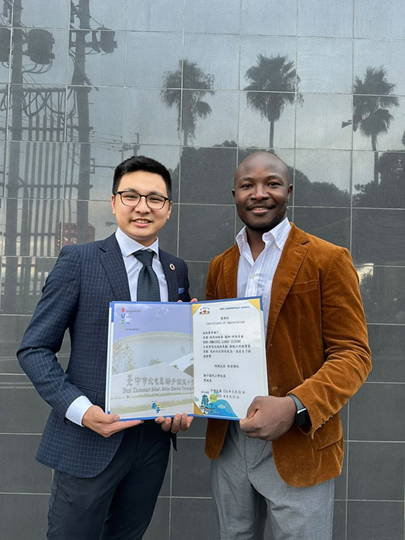
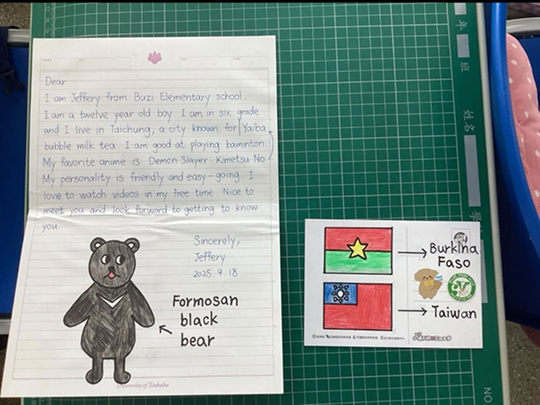
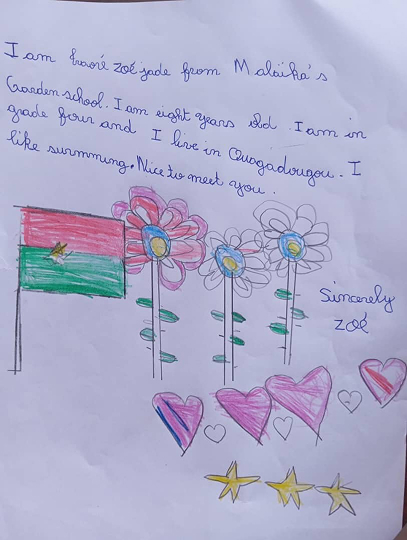
Wang’s mother runs an elementary school, and he asked Emma if it might be possible to connect her students with those in Burkina Faso. From there, the project gradually took shape. It started with exchanging postcards in English and then moved on to using Padlet, an online platform for sharing ideas, to deepen the interaction. If this momentum continues, more than 500 students in Taiwan and Burkina Faso will gain cultural understanding, broaden their international perspectives, and learn English through friendship.
Taiwan and Burkina Faso share an interesting similarity: neither country uses English as a first language, yet both encounter English frequently. Because these students speak different native languages—Chinese and French, respectively—they don’t need to aim for “perfect English.” Instead, they can express what they want to say without fear of mistakes. This exchange isn’t about shrinking under the pressure of native speakers; it’s a unique learning opportunity where everyone can challenge themselves to boldly use English.
It’s precisely because of APU’s campus environment that students from Taiwan and Burkina Faso, who might never have crossed paths otherwise, can share their aspirations and connect across the globe through the internet. The desire to “do something” transcends borders, gender, and age. This project reminds us of this simple yet often forgotten truth. I feel fortunate to have captured and put into words such a moment. APU is full of stories like this. As far as I know, there isn’t a single student doing nothing. APU is precisely that kind of wonderful university.
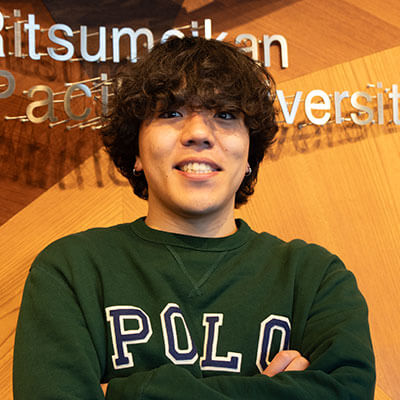
I want to write articles that will help APU students love their university even more! Additionally, I aim to share the greatness of APU that only current students understand with middle and high school students interested in APU!




Copyright (c) 2016 Ritsumeikan Asia Pacific University


