


Please enter search keywords
3 min read
March 14, 2026. The APU campus buzzed with an unusual kind of energy. Students from Kyushu Institute of Technology and the Institute of Science Tokyo had arrived, laptops under their arms, lines of code already forming in their heads. This was the Kyutech × Science Tokyo × APU Joint Hackathon 2026.
We were three business students and one social science student competing against some of Japan’s brightest engineering minds in a 72-hour hackathon. On paper, it looked like a mismatch. In practice, it became our greatest advantage.
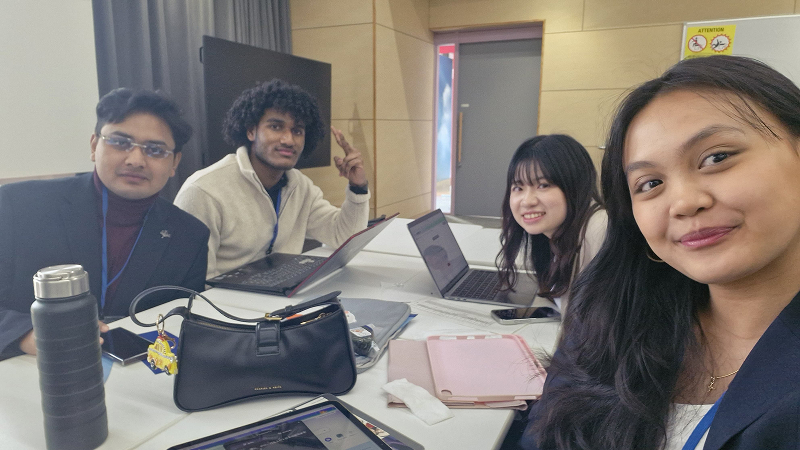
SIDDIK MD TANVIR (College of International Management 2nd Semester, Research and Systems); SAMEER MOTWANI (College of International Management 2nd Semester, Lead Developer); IMAI KIKO (College of International Management 7th Semester, Presentation Lead); LIMBACO JEANA SOPHIA ANTOLIN (College of Asia Pacific Studies 2nd Semester, Strategy and Concept)
Every hackathon lives and dies by its idea. Technical skill can execute, but it cannot replace a problem worth solving. This is where APU’s unique environment gave us something no engineering curriculum could.
At APU, over half the student body comes from outside Japan. Every day, we navigate the gap between where we come from and where we are. We speak different languages. We interpret silence differently. We misread cues that feel obvious to others. The job market is where these misunderstandings become costly — and largely invisible.
That insight became MIRU.
“Not a language problem. A cultural one. MIRU makes those invisible signals visible.” MIRU is an AI interview coach designed for foreigners navigating the Japanese job market. It simulates a real Japanese HR manager — formal, and emotionally restrained — and silently evaluates users across the five dimensions Japanese companies often use to assess candidates. Then it switches to English and explains what the interviewer was actually thinking.
The interviewee says: “I want to grow my career here.”
The interviewers hear: “This person is here to take, not to give.”
That invisible gap is exactly what MIRU was built to close. Voice-driven, Claude-powered, and trained using real company profiles from renowned Japanese companies.
Over three intense days at APU, our team played to its strengths. Sameer drove the technical architecture, coding almost nonstop and transforming the concept into a working voice-driven product. I (Siddik) focused on research and content development, grounding MIRU’s logic in the realities of Japanese hiring culture. Jeana kept the team aligned and focused throughout the competition. Kiko became the bridge our product itself was trying to build — presenting MIRU in Japanese to a judging panel.
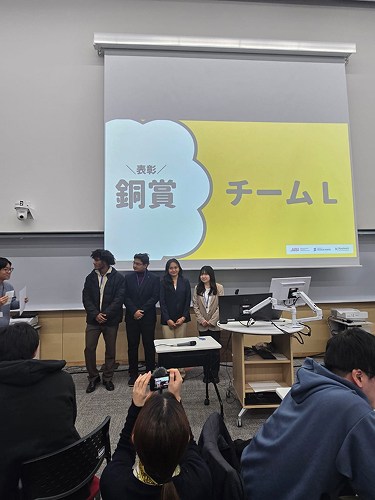
The panel was impressed. We earned the Bronze Prize — the only APU team on the podium among more than fifteen teams from two of Japan’s leading technical universities.
There is a persistent myth that technology competitions belong only to engineers — that the only people who deserve a seat at the hackathon table are those who can write elegant code or design complex systems. MIRU challenges that myth directly.
APU is not an engineering university. But it is something arguably rarer: a place where students from over 100 countries live, study, argue, and build together. Your classmate in Monday’s seminar may be from Indonesia, your study partner on Wednesday from Ghana, and the person helping you understand Japanese business culture on Friday may have grown up in Osaka.
That environment develops a kind of intelligence no technical curriculum can manufacture — the ability to recognize problems others cannot see because you have lived them yourself. The cultural gap in Japanese job interviews is not a problem most engineering students would naturally think to solve. It emerges from the lived experience of trying to belong in a different culture.
MIRU works not simply because it was built by engineers, but because it was built by people who understood the problem from the inside. That is the APU advantage — and it is more transferable than any programming language.
MIRU still has a long way to go. A 72-hour hackathon prototype is not a finished product. But the Bronze Prize is not really the point. What matters is what it proves: APU students can walk into rooms that were not built for them, solve problems others have not noticed, and leave a mark.
The hackathon theme was “Crossing Borders, Creating Connections.” For many teams, it was a metaphor. For us, it described daily life.
If you are hesitating to enter a competition, apply for an internship, or pursue an opportunity because you think it was not built for you — look at what MIRU stands for.
Look at the possibilities. Seize the opportunity.
* “Hackathon” is a coined term combining “hack” and “marathon.” It is an event in which participants collaborate on ideas around a specific theme, develop applications or services within a limited period of time, and compete based on the results.






Copyright (c) 2016 Ritsumeikan Asia Pacific University


